LEGISLATION TO TEMPORARILY OFFER TO-GO SALES OF BEER AND WINE EXPECTED ON TUESDAY – GOVERNOR SAID HE WILL SIGN

n105-0399-cold-beer-and-wine-to-go-neon-sign

Legislation that allows restaurants to temporarily offer to-go sales of beer and wine is expected to be considered by the Minnesota Legislature on Tuesday.  Governor Tim Walz said if they are able to pass the bill he will sign it during a daily press briefing as heard on KROX on Monday afternoon.

“Businesses across Minnesota have been devastated by the events of recent weeks. They’ve made the best of the situation by offering to-go sales of food – and there’s no reason they shouldn’t be allowed to sell their inventories of alcohol and make cash now,” said Senator Karin Housley (R-St. Marys Point), the bill’s chief author. “Minnesotans have turned out in droves to support their hometown establishments – and I suspect they will take advantage of these expanded offerings, too. The governor has committed to sign this bill. Let’s do our jobs and send it to his desk.”

The bill will temporarily allow all establishments with current on-sale liquor licenses to sell beer and wine for off-premise consumption, in addition to their takeout food offerings, for the duration of the peacetime emergency declaration. The alcoholic beverages will be required to be sold in the original, unopened packaging, and be limited to 144 ounces per order for beer and 1500 milliliters per order for wine. The governing body of any municipality may vote to prohibit off-sale alcohol within its jurisdiction.

The bill, of which Representative Jon Koznick (R-Apple Valley) is the author in the House of Representatives, will be introduced at Tuesday’s session.

“They’re doing this in Texas, Arizona, California, Colorado, South Carolina, and many other states. This has bipartisan agreement and is something that can be done immediately to help hurting small businesses,” continued Senator Housley.
Senator Karin Housley, of St. Marys Point, represents the Forest Lake area and the St. Croix River Valley in the Minnesota Senate. Senator Housley is chairwoman of the Family Care and Aging Committee and is an assistant majority leader.

SEVERE WEATHER, LIGHTNING, AND HAIL – SEVERE WEATHER AWARENESS WEEK

The Tuesday topic for Severe Weather Awareness Week is Severe Weather, Lightning, and Hail.  Warm, humid conditions are favorable to storm development and storms typically are small producing heavy rain and wind over a relatively small area for a brief period of time explains Crookston Firefighter Justin Johnson. “They are relatively small, about 15 miles in diameter and will last about 30 minutes,” said Johnson.  “Severe thunderstorms can produce large hail and heavy winds of at least 58 mph. Some wind gusts can exceed 100 mph and produce tornado-like damage. About 10 percent of storms are severe and may occur in clusters or lines.”

The best place to in a storm is a basement with water pipes and electrical explains Johnson. “The safest place to be during a thunderstorm is in the basement of any normal building away from windows,” said Johnson.  “Most hardtop cars are safe from lightning.  Convertibles, motorcycles, bicycles and fiberglass vehicles offer no protection from lightning.  Avoid contact with interior metal during a storm.”  

It’s important to remember if you can hear thunder lightning can strike you and the only safe place is inside. “No place outside is safe when thunderstorms are in the area,” said Johnson.  “If you hear thunder, lightning is close enough to strike you.  When you hear thunder, immediately move to a safe shelter, a building or a closed metal top vehicle with windows up.  And stay in a safe shelter for at least 30 minutes after you hear the last sound of thunder.”

Getting struck by lightning is more common than you might think with 240,000 people struck each year.  “Lightning bolts can be over five miles in length,” said Johnson.  “Lightning can strike up to 15 miles away from the center of the storm.  National Weather Service data says the chance of being struck by lightning once in your lifetime is 1 in 12,000.”

Hail will also accompany thunderstorms and the larger the hail the faster it falls making it more dangerous. “Hail can range from pea-size, which is most common, to baseball size or bigger,” said Johnson.  “Large hailstones fall faster than 100 mph and can severely injure or kill people.”

Minnesota’s statewide tornado drill will take place on Thursday.  Outdoor warning sirens and NOAA Weather Radios across the state will be sounded at 1:45 p.m. and 6:45 p.m.

UPDATED HIGHWAY CLOSURES DUE TO FLOODING IN NORTHWEST MINNESOTA

The Minnesota Department of Transportation continues to warn motorists of the travel advisories issued in northwest Minnesota due to flooding. Use caution and obey road signs posted in the area.

Highways that remain closed:

  • Highway 1 from Oslo to CR 17
  • Highway 2B Sorlie Bridge in East Grand Forks
  • Highway 175 between North Dakota and CR 34, west of Hallock
  • Highway 220 north of Oslo, between Highway 1 and Highway 11
  • Highway 317 between Highway 220 and North Dakota border
  • Highway 102 northwest of Fertile from Hwy 32 to CR 44

Highways that have been opened and are clear of water:

  • Hwy 75 north of Climax
  • Hwy 220 south of Alvarado

MnDOT cautions motorists to be alert for the potential of road flooding throughout northwest Minnesota as additional precipitation and heavy snowpack continue to melt and water levels rise. Highways could be closed at times if water poses a safety hazard to motorists. Areas that have water on the road or are closed because of flooding are marked on MnDOT’s road conditions map at www.511mn.org.

When a road is closed it is illegal to travel in that area. Motorists can be fined up to $1,000 and/or 90 days in jail. In addition, if travelers need to be rescued from a closed road, other expenses and penalties will apply.

MINNESOTAN’S STRUGGLING TO PAY UTILITY BILLS ENCOURAGED TO CONTACT THE UTILITY

citizens-utility-board

The Citizens Utility Board (CUB) is encouraging any Minnesotan who is behind on their electricity or natural gas bills to contact their utility to ensure their service remains connected during the COVID-19 pandemic.

Many Minnesota electricity and gas utilities are providing extra flexibility to customers who are struggling to stay current on their bills during the COVID-19 pandemic, including arranging payment agreements. However, in the majority of areas, customers must contact their utility and arrange a payment plan to ensure that their service will not be disconnected.

Policies vary by utility. Xcel, Minnesota Power, CenterPoint, and Otter Tail Power Company are among those utilities who have suspended disconnections for non-payment. Most other utilities are offering to extend additional flexibility, including payment arrangements to customers who contact them.

“It’s essential that people’s utilities remain on during the pandemic,” said Annie Levenson-Falk, CUB’s executive director. “For people to comply with the Stay At Home order, every home needs electricity, heat, and hot water.”

“We thank the many utilities who are extending much-needed accommodations to their customers during this time,” said Levenson-Falk. “Unfortunately, we also know that some people are dealing their power being disconnected.” 

For consumers who are behind on their bills, worried about their service being disconnected, or have already had their service disconnected, CUB recommends:

  • Call your utility and ask to arrange a payment plan that works given your personal financial circumstances. Ask them to ensure your service remains on and to waive late fees during the federal or state declared COVID-19 emergency.
  • If you have been financially affected by the COVID-19 emergency, make sure to tell them. Some utilities are making special arrangements for people who have been affected that may not be available to people undergoing financial hardships for other reasons.
  • CUB strongly recommends that you make at least partial payments on your bills as you are able. Even if your service will not be disconnected during this period, your bills will continue to accumulate. Any payments you can make now will reduce the amount you owe when the emergency order is eventually lifted and utilities begin disconnection proceedings again.

Consumers who have questions or are unable to reach an agreement with their utility are encouraged to contact CUB: 651-300-4701 or info@cubminnesota.org. CUB staff provide individualized advice to consumers regarding their options and how to save money on their bills, and can advocate on consumers’ behalf. Services are provided at no charge.

Energy Assistance is also available for households making less than 50% of state median income through local providers. Minnesota is receiving additional Energy Assistance funds from the federal CARES Act. Applicants now need only show one month’s qualifying income (rather than the usual three months), and the State of Minnesota has extended the deadline for applications to July 15, though funds are still available on a first-come, first-served basis.

Additional information can be found at http://cubminnesota.org/covid-19/.

GOVERNOR WALZ EXTENDS PEACETIME EMERGENCY FOR ADDITIONAL 30 DAYS

Today, Governor Tim Walz signed Executive Order 20-35 extending the peacetime emergency in Minnesota for 30 days.

“Our actions have saved lives, but the threat of COVID-19 remains,” said Governor Walz. “The next stages of this pandemic are going to challenge us – an extension of Minnesota’s peacetime emergency will allow us to protect Minnesotans’ health and wellbeing and continue to respond effectively to this rapidly-evolving situation.”

Governor Walz declared a peacetime emergency to respond to the COVID-19 pandemic on March 13, 2020. On March 15, Minnesota detected the first confirmed cases caused by “community spread”—infections not epidemiologically linked to overseas travel. By March 17, all 50 states had reported a confirmed case of COVID-19. And on March 21, the Minnesota Department of Health announced the first confirmed fatality due to COVID-19 in Minnesota.

Since the Governor declared a peacetime emergency, Minnesota has taken strong steps to respond to and provide relief for COVID-19: closure of schools and implementation of a distance learning period; enhanced protections for veterans in our veterans’ homes; activation of the National Guard to assist in relief efforts; measures to preserve personal protective equipment; temporary closure of bars, restaurants, and other places of public accommodation; efforts to provide economic relief and stability to those impacted by the pandemic; regulatory changes allowing our state agencies and licensing boards to ensure fast relief to Minnesotans; and an order directing Minnesotans to stay at home to slow the spread of the virus. Today’s extension of the peacetime emergency is necessary for many of these measures to continue.

This extension of the peacetime emergency is effective today through May 13, 2020, and the Governor will seek the Executive Council’s approval of the extension this afternoon.

MINNESOTA DEPARTMENT OF HEALTH RELEASES COVID-19 NUMBERS (April 13)

statslab-4

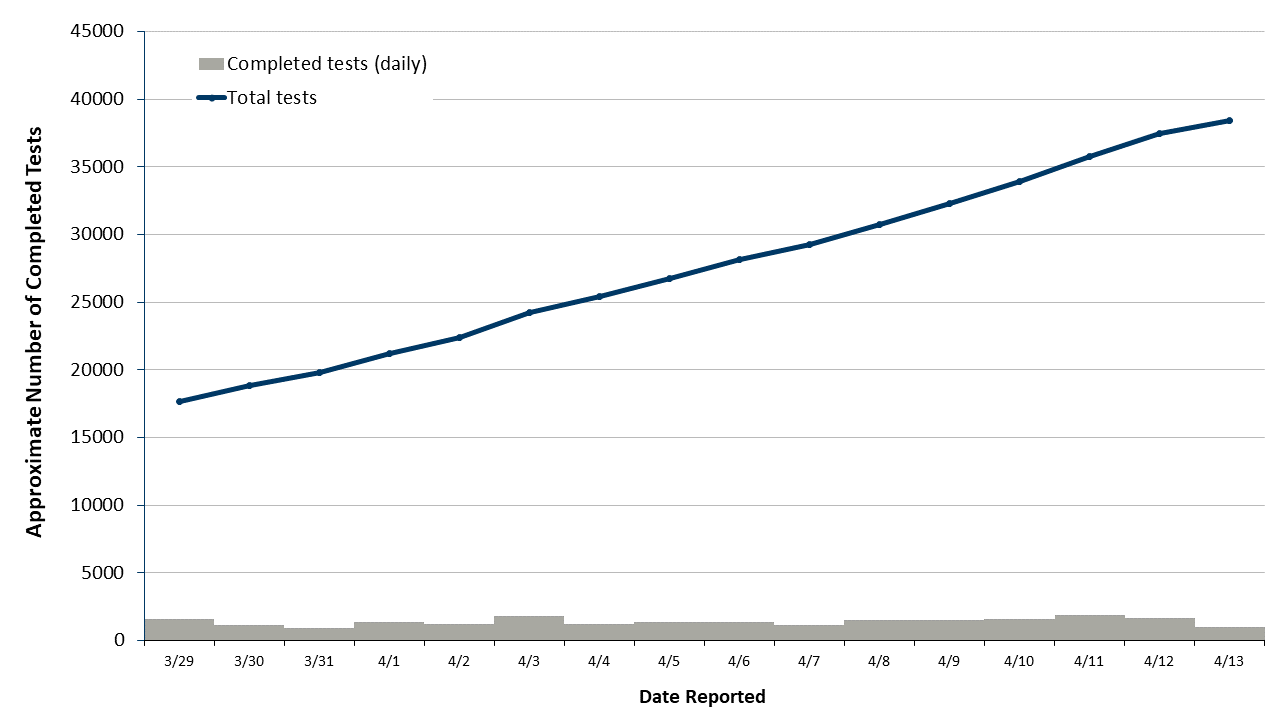
The Minnesota Department of Health has released the latest COVID-19 numbers for the state.  The death total is 70. Polk County still only has one positive test, but Red Lake County has received the first positive test.

Data is for cases that were tested and returned positive. Numbers are cumulative since Jan. 20, 2020. All data are preliminary and may change as cases are investigated.
Not all suspected cases of COVID-19 are tested, so this data is not representative of the total number of people in Minnesota who have or had COVID-19.

Updated April 13, 2020.
Updated daily at 11 a.m., with data current as of 4 p.m. the previous day.
Data for April 12 was as of 8 p.m. April 11.

Dates provided are those when the case, hospitalization, or death was first posted in this situation report.

Testing

Total approximate number of completed tests: 38,427

  • Total approximate number of completed tests from the MDH Public Health Lab: 9,441
  • Total approximate number of completed tests from external laboratories: 28,986

Testing data table

Minnesota Case Overview

Total positive: 1,650

Graph of confirmed cases of COVID-19, data in table below.

Positive case data table

  • Patients no longer needing isolation: 842

Patients no longer needing isolation in Minnesota, data in table below

No longer needing isolation data table

  • Deaths: 70

Deaths of confirmed cases in Minnesota, data in table below

Deaths data table

Hospitalization

Total cases requiring hospitalization: 361

  • Hospitalized as of today: 157
    • Hospitalized in ICU as of today: 74

Minnesota COVID-19 hospitalizations , data in table below

Hospitalization data table

Case Demographics

Age

Age Groups for confirmed COVID-19   cases in Minnesota, data in table below.

Age group data table

More age data: Age median and range (all cases, non-hospitalized, hospitalized and deaths)

Gender

  • 50% female, 48% male, 0% other, 2% unknown/missing

Race & Ethnicity

Race and ethnicity for confirmed COVID-19 cases in Minnesota: data in table below.

Race and ethnicity data table:
Including race and ethnicity of deaths

Cases can have more than one race.

Likely Exposure

Likely exposure for confirmed COVID-19   cases in Minnesota: data in table below.

Likely exposure data table

Cases by County of Residence

County of residence is confirmed during the case interview. At the time of this posting not all interviews have been completed. The county residence data may not equal the total number of reported positive cases.

County of residence data table:
Including county of residence of deaths

More about location data

How to use the interactive map

Residence Type

Residence type for confirmed COVID-19   cases in Minnesota: data in table below.

Residence type data table

Care Facilities

Congregate Care Facilities with Exposures, by County


FIVE MEN ARRESTED IN SUNDAY NIGHT ASSAULT AND BURGLARY IN GRAND FORKS

On Sunday, April 12 at approximately 10:55 p.m. the Grand Forks Police Department responded to call of an assault that occurred prior.  The initial investigation indicated that multiple individuals entered an apartment without permission, assaulted an individual within that apartment, and illegally transferred funds electronically from the person assaulted to one of the individuals present.  Several, but not all, of the suspects involved in the incident, were known to the victim.  The initial investigation indicated the suspects were in another apartment within the same building.

Given the nature of the incident, a search warrant was obtained for the suspect apartment.  Upon announcement of the search warrant, and unlocking the door, all suspects exited the apartment without incident.

At the conclusion of the initial investigation, the following individuals were charged as noted below.  It should be emphasized that this investigation remains active and ongoing, and additional charges for one or more of the individuals involved in this incident may be forthcoming.

  • Luke Drougas, a 20-year-old Grand Forks resident, was charged with: BURGLARY, ROBBERY, AGGRAVATED ASSAULT, & TERRORIZING.
  • Keegan Hofstad, a 19-year-old Grand Forks resident, was charged with: BURGLARY & ROBBERY.
  • Mason Demontigny, a 19-year-old Fargo resident, was charged with:    BURGLARY & ROBBERY.
  • Austin Suedel, a 21-year-old Grand Forks resident, was charged with:  BURGLARY & ROBBERY.
  • Jacob Busch, a 20-year-old Fargo resident, was charged with:  BURGLARY.

Anyone with information on this, or any related, incident, is encouraged to contact the Grand Forks Police Department by one of the following methods:

Call:                       701-787-8000
Online:                 Submit a tip via the GFPD’s Facebook or website
App:                     Submit a tip via the Tip411 app

USDA UNVEILS TOOLS TO HELP RURAL COMMUNITIES ADRESS COVID-19 PANDEMIC

U.S. Secretary of Agriculture Sonny Perdue today unveiled a one-stop-shop of federal programs that can be used by rural communities, organizations and individuals impacted by the COVID-19 pandemic. The COVID-19 Federal Rural Resource Guide (CLICK HERE TO VIEW THE GUIDE) is a first-of-its-kind resource for rural leaders looking for federal funding and partnership opportunities to help address this pandemic.

“Under the leadership of President Trump, USDA is committed to being a strong partner to rural communities preparing for and impacted by COVID-19,” Perdue said. “This resource guide will help our rural leaders, whether they are in agriculture, education, health care or any other leadership capacity, understand what federal assistance is available for their communities during this unprecedented time.”

USDA has taken many immediate actions to assist farmers, ranchers, producers, rural communities, and rural-based businesses and organizations impacted by the COVID-19 pandemic. For more information on these actions, visit www.usda.gov/coronavirus.

Parts Of U.S. Could Reopen In May As Coronavirus Nears Peak

tmp35acfbf6-c7d0-4588-b103-1929a18da117-jpg

On Sunday, public health officials discussed the possibility of partially reopening parts of the economy from government-mandated lockdowns as soon as next month, despite U.S. coronavirus infection and death totals continuing to climb. As of Sunday morning, there are more than 530,000 confirmed infections in the United States – accounting for roughly 30% of the more than 1.8 million people infected around the world. More than 20,000 Americans and more than 110,000 people globally have died.

The number of confirmed cases in the U.S. climbed by nearly 200,000 over the course of the past week, however, White House officials are pushing to reopen the economy as quickly as possible, given the catastrophic economic damage that has unfolded by shuttering nonessential businesses across the country.

More than 16 million Americans filed initial unemployment claims during the final two weeks of March and in the first week of April. Gross domestic product numbers during April, May and June are expected to be among the worst in modern history. Some estimates see the unemployment rate climbing as high as 30%.

During an appearance Sunday morning on CNN’s “State of the Union,” Anthony Fauci, the director of the National Institute of Allergy and Infectious Diseases, said a partial May reopening could be possible in some parts of the country. But he warned it would have to be done on a rolling basis – and that some particularly hard-hit parts of the country may need to wait longer. “It is not going to be a light switch that we say ‘OK, it is now June or July or whatever, click, the light switch goes back on.’ It is going to be depending on where you are in the country, the nature of the outbreak that you’ve already experienced and the threat of an outbreak that you may not have experienced,” he said, stressing that a reopening of the economy would not be “one-size-fits-all.”

Health Officials: Economy Could Reopen in May Amid Coronavirus Pandemic

Via www.usnews.com
 

Tornado Strikes Northern Louisiana Amid Sever Weather In The Southern U.S.

tmpc5288ed5-7103-4f05-bf59-02210db340ff-jpg

Tornadoes struck northern Louisiana on Sunday afternoon, causing damage to nearly two dozen homes and an airport, as a severe storm system passed through the South.

As most people continued to stay at home on Easter Sunday due to the pandemic coronavirus, 95 million people were prepared to be possibly impacted by the storm, including the threat of tornadoes.

About 20 homes were reported to have sustained damage plus multiple planes and hangers were damaged at the Monroe Regional Airport, according to the National Weather Service. The City of Monroe, Louisiana confirmed reports of wind damage in multiple neighborhoods, including downed power lines, as well as office buildings in the airport complex. All flights were canceled “until further notice,” according to a Twitter post by the city.

Tornado strikes Monroe, Louisiana, as severe weather outbreak unfolds on Easter in South

Via www.msn.com